
Mera Peak Expedition
Duration
22 Days
Max Altitude
6,476m
Difficulty
Medium
Group Size
2-12 People
Best Season
Spring and Autumn
About Mera Peak Expedition
Title: Mera Peak Expedition 2026 | 6,476m Peak Climbing in Nepal's Hinku Valley
Description: Climb Mera Peak (6,476m) - Nepal's highest officially designated trekking peak through the remote and pristine Hinku Valley. A perfect high-altitude introduction to Himalayan mountaineering. Book your 2026 expedition with Adventure Pathway.
Focus Keyword: Mera Peak Expedition
Secondary Keywords: Mera Peak climbing Nepal, Mera Peak 6476m trek, Nepal trekking peak expedition, Hinku Valley trek, high altitude climbing Nepal 2026, best beginner Himalayan peak Nepal, Mera Peak permit Nepal, Lukla to Mera Peak trek
Short Description
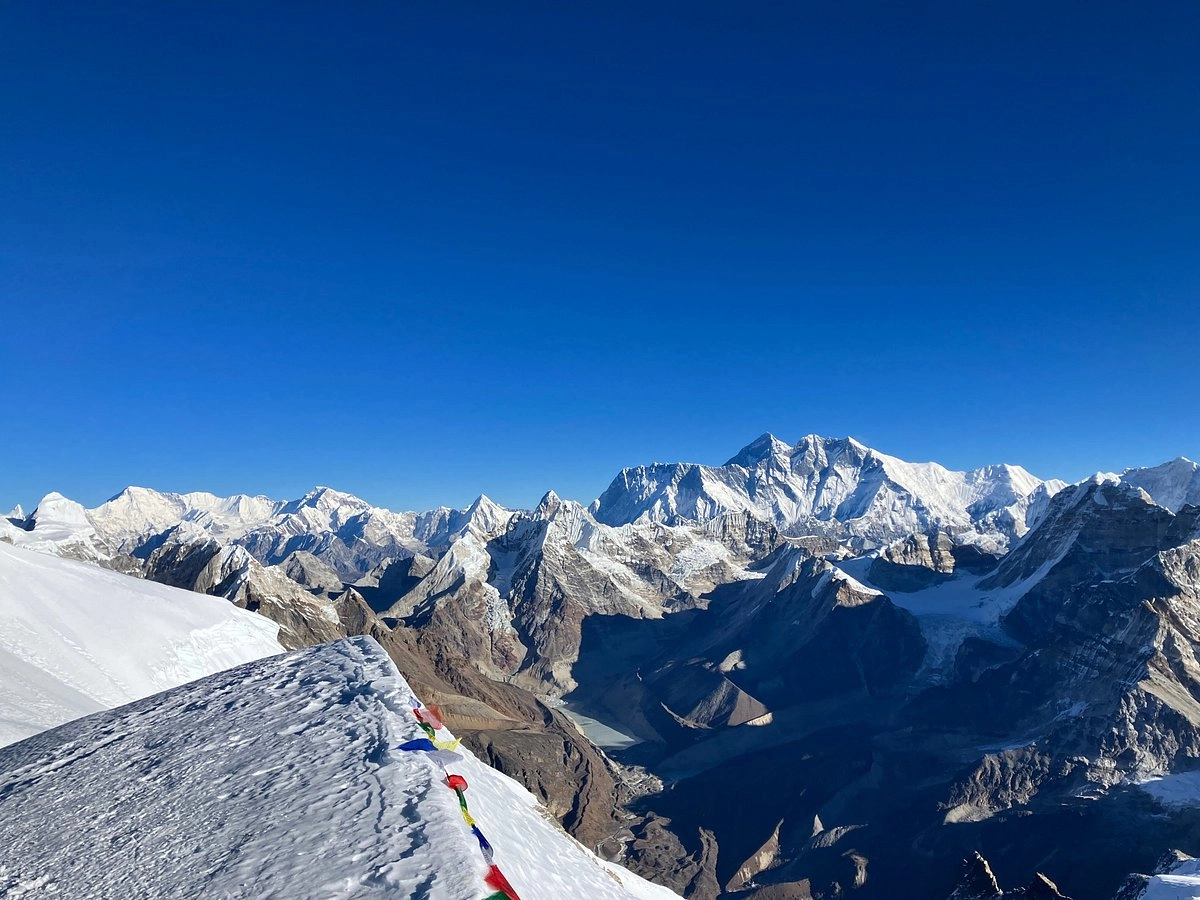
Towering at 6,476 meters above the remote and strikingly beautiful Hinku Valley of eastern Nepal, Mera Peak holds the distinguished title of Nepal's highest officially designated trekking peak. From its broad, wind-swept summit plateau, five of the world's fourteen 8,000-meter giants stand visible simultaneously Everest, Lhotse, Makalu, Cho Oyu, and Kanchenjunga creating what is widely regarded as the single most expansive high-altitude panorama achievable on any trekking peak in the country. For mountaineers taking their first serious steps into the world of Himalayan high-altitude climbing, Mera Peak is the ultimate starting point, technically accessible, profoundly rewarding, and unforgettable in every dimension.
Overview
The Mera Peak Expedition occupies a unique and highly coveted position in Nepal's peak climbing landscape. As the highest trekking peak in the country, it sits precisely at the intersection of ambitious trekking and genuine mountaineering, demanding more than a standard high-altitude walk but remaining achievable for well-prepared climbers without extensive prior technical mountaineering experience. This is not a mountain to be underestimated, but it is a mountain that welcomes determined first-time high-altitude climbers with a route of remarkable accessibility and a summit reward of extraordinary scale.
The approach to Mera Peak through the Hinku Valley is itself one of the great unsung journeys of the Nepal Himalaya. Unlike the heavily trafficked corridors of the Everest and Annapurna regions, the Hinku Valley receives a fraction of the trekking traffic its trails winding through dense rhododendron and bamboo forests, crossing high jungle ridges alive with birdlife, and gradually ascending into an alpine wilderness of breathtaking scale and silence. The valley feels genuinely remote, a place where the mountains have not yet been commodified, where teahouses retain their authentic simplicity, and where encounters with wildlife and untouched forest are daily occurrences rather than occasional surprises.
Above the treeline, the upper Hinku Valley transforms into a landscape of immense glacial grandeur. The Mera Glacier, one of the largest in the Khumbu region flows south from the mountain's broad upper snowfields, its surface a chaotic mosaic of seracs, crevasses, and wind-polished ice that the approach trail navigates with careful precision. Mera High Camp at 5,800 meters sits on the glacier's upper plateau a windswept, otherworldly location where the horizon is defined entirely by 6,000 and 7,000-meter peaks and the scale of the Himalayan world becomes viscerally, overwhelmingly real.
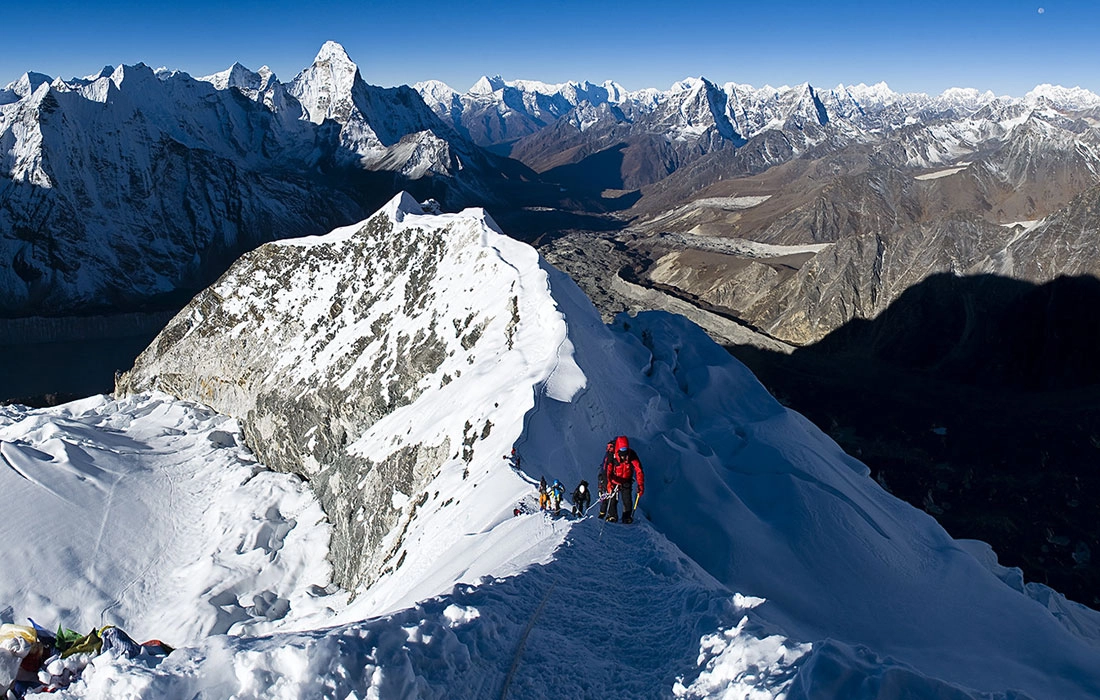
The summit of Mera Peak itself is not a single sharp point but a broad, elevated plateau, a rare gift at high altitude that allows summit teams to pause, breathe, and absorb the panorama without the anxiety of a narrow exposed ridge beneath their feet. Standing at 6,476 meters with five 8,000-meter giants arranged across the horizon in a single sweeping arc is an experience that reduces even the most seasoned mountaineers to silence. This is why Mera Peak is not merely a training climb for greater objectives for many climbers, it is the most memorable summit of their entire mountaineering career.
At Adventure Pathway, the Mera Peak Expedition is designed with meticulous attention to acclimatization, safety, and the quality of the overall mountain experience. Our expeditions are led by senior certified guides with extensive Mera Peak experience, supported by experienced Sherpa climbing staff, and operated with full respect for the ecological sensitivity of the Makalu Barun National Park buffer zone through which the approach trail passes.
Key Information
- Region: Khumbu / Hinku Valley, Solukhumbu District, Eastern Nepal
- Summit Elevation: 6,476 meters
- Base Camp Elevation: Mera Base Camp — 5,300 meters
- High Camp Elevation: Mera High Camp — 5,800 meters
- Standard Route: North Face / Northwest Ridge
- Starting Point: Kathmandu
- Flight Route: Kathmandu – Lukla – Kathmandu
- Difficulty Level: Moderate — Introductory High-Altitude Mountaineering
- Ideal For: First-time high-altitude climbers, experienced trekkers stepping into mountaineering, adventure enthusiasts
- Main Attractions: Mera Peak summit, five 8,000m peak panorama, Hinku Valley wilderness, Mera Glacier, remote Sherpa villages
- Accommodation: Hotel in Kathmandu, teahouses on approach, tented expedition camps on the mountain
- Best Climbing Season: October to November (Autumn) & April to May (Spring)
- Permits Required: Mera Peak Climbing Permit (Nepal Mountaineering Association), Sagarmatha National Park Permit, Khumbu Pasang Lhamu Rural Municipality Permit
- Expedition Duration: 22 Days
Day-by-Day Itinerary
Touch down at Tribhuvan International Airport and transfer to your expedition hotel in Kathmandu. Your Adventure Pathway expedition coordinator meets the team for an introductory briefing covering the full itinerary, permit documentation, gear verification, acclimatization strategy, and an overview of the Hinku Valley approach route. Team dinner and early rest in preparation for the morning flight.
A dedicated day for equipment organization, permit collection from the Nepal Mountaineering Association, final gear purchases in Thamel, and team introductions. The expedition leader conducts a detailed technical briefing on crampon technique, ice axe use, rope team movement, and fixed line ascending skills that will be put into practice on the mountain in the days ahead.
Board the exhilarating mountain flight to Lukla before turning south and east away from the crowded Everest trail immediately entering the quieter, less-traveled approach corridor toward the Hinku Valley. The trail climbs through terraced farmland and scattered Sherpa settlements to the first overnight camp at Chutanga or Paiya.
A significant day of ascent crossing the Zatrawala Pass (4,610m) the gateway ridge separating the Dudh Koshi valley from the remote Hinku drainage. The pass delivers sweeping views back toward the Everest massif on a clear day before the trail descends steeply into the upper Hinku Valley. Kothe is a small seasonal settlement set dramatically at the forest edge with towering peaks appearing above the valley walls.
The Hinku Valley opens dramatically above Kothe — the trail following the river through increasingly alpine terrain as the rhododendron and birch forest gives way to open meadows and the first rocky moraine ridges of the glacier system above. Thangnak sits on a wide flat bench above the valley with the first genuine views of Mera Peak's glacier system appearing to the north.
A shorter but important acclimatization stage climbing steadily up lateral moraines and ablation valleys to Khare the last permanent settlement and main staging point for the Mera Peak climb. The transition into the high-altitude zone above 5,000 meters is immediately noticeable, the air thins perceptibly, movement slows, and the mountain environment takes on the stark, magnificent character of the true Himalayan high country.
A critical dual-purpose day at Khare. Morning acclimatization hike to the ridge above the village (approximately 5,300m) for altitude adaptation and expanding views of the Mera Glacier above. Afternoon technical training session on the snow and ice terrain near camp practicing crampon fitting and movement, ice axe technique, rope team travel, and jumar ascending on fixed lines. This practical skills session is invaluable preparation for the summit days ahead.
Move up onto the Mera Glacier and establish base camp on the broad snowfield below the mountain's north face. The approach involves basic glacier travel with crampons, the first genuine climbing movement of the expedition and delivers the team onto a spectacular elevated platform with panoramic views of Charpati Himal, Mera Central, and the surrounding glaciated peaks.
A full rest day at base camp for physiological adaptation to 5,300 meters. Route inspection of the upper mountain, weather monitoring, gear checks, and team health assessments occupy the day. The expedition cook team prepares high-calorie meals to support the acclimatization process and energy reserves for the summit rotation above.
The team moves deliberately up the Northwest Ridge from base camp to high camp a sustained snow and moderate ice slope requiring steady crampon movement and careful rope management. The high camp at 5,800 meters sits on a wind-exposed glacier platform with the summit plateau visible directly above and an ocean of Himalayan peaks stretching to the horizon in every direction. Early dinner and maximum rest in preparation for the predawn summit start.
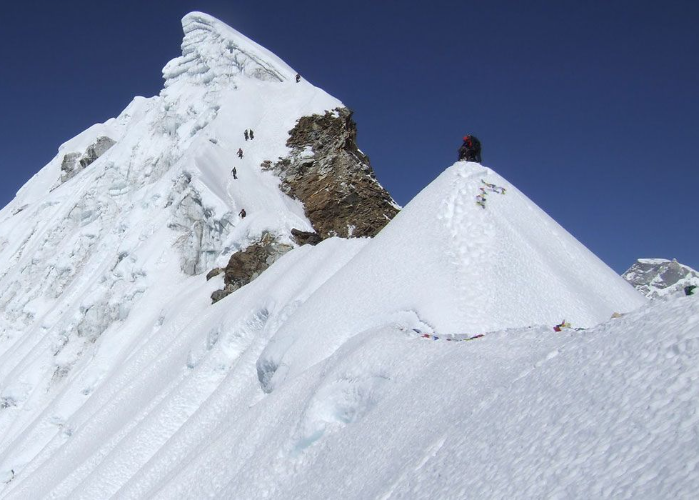
Departure from high camp begins between 2 and 4 AM by headlamp in the predawn darkness. The summit route follows the broad Northwest Ridge, a sustained snow slope of moderate angle that becomes steeper in the final 200 meters before the plateau. Fixed ropes assist the steepest sections, and the entire team moves in roped pairs with Sherpa guide support throughout. Cresting the summit plateau as dawn breaks across the eastern Himalaya is a moment of singular, breathtaking power.
Five 8,000-meter peaks Everest (8,849m), Lhotse (8,516m), Makalu (8,481m), Cho Oyu (8,188m), and Kanchenjunga (8,586m) stand visible simultaneously across a panoramic arc that encompasses the greatest concentration of extreme altitude on the surface of the planet. Descend carefully to base camp for full rest and celebration.
A buffer day built into the itinerary for teams requiring additional recovery after the summit day, or for a second summit attempt if the primary bid was turned back by weather or conditions. Teams who summited successfully use this as a full rest and celebration day before beginning the descent.
Descend off the glacier and return to Khare for the first night below 5,000 meters since the ascent began. The lower altitude brings immediate physiological relief, deeper sleep, improved appetite, and the warm satisfaction of a successful summit in the rearview mirror.
A long descending day retracing the approach trail through the Hinku Valley the vegetation returning rapidly as altitude drops and the warmth and greenery of the lower forest providing a welcome contrast to the stark glacier world of the previous week.
Continue the descent through the lower Hinku Valley, passing through small Rai and Sherpa settlements that feel like a different world compared to the high glacier camps above. The trail drops through dense mixed forest with increasing warmth and humidity signaling the return to lowland Nepa
The final full trekking day of the expedition returning over the lower approach ridges toward Lukla through terraced farmland, small stone villages, and the distinctly different cultural world of the lower Solukhumbu valleys.
Board the morning mountain flight back to Kathmandu. Transfer to the expedition hotel for a final night of hot showers, comfortable beds, and the deep satisfaction of a successful Himalayan summit accomplished.
Arrive in Lukla for a final evening with the expedition's Sherpa team, a celebratory dinner and the warm exchange of farewells with guides, porters, and support staff who made the summit possible.
A free day in Kathmandu for sightseeing, shopping in Thamel, relaxation, and the expedition summit celebration dinner hosted by Adventure Pathway, a fitting tribute to the team's achievement on Nepal's highest trekking peak.
Two additional buffer days built into the Kathmandu schedule to absorb any weather-related flight delays from Lukla, a common occurrence in both spring and autumn seasons that experienced expedition operators always account for in their scheduling.
Transfer to Tribhuvan International Airport for your onward international flight carrying the memory of five 8,000-meter peaks seen simultaneously from 6,476 meters, and a Nepal Mountaineering Association summit certificate as permanent proof of what was accomplished.
What's Included & Not Included
Included
- Airport pick-up and drop-off service in Kathmandu
- Round-trip domestic flights (Kathmandu–Lukla–Kathmandu)
- Expedition hotel accommodation in Kathmandu (twin sharing, bed and breakfast)
- Teahouse accommodation on the approach and descent trekking sections
- Fully equipped tented expedition camps at Mera Base Camp and Mera High Camp
- All meals throughout the expedition (teahouse full board on approach, expedition cook team at base camp and high camp)
- High-calorie summit day provisions and thermos flask service
- Experienced certified expedition leader and English-speaking senior guide
- Licensed Sherpa climbing guide throughout the mountain sections (1 Sherpa per 2 climbers)
- Complete rope team equipment fixed ropes, snow stakes, ice screws
- High camp tent equipment (sleeping tents, dining tent, kitchen tent)
- Glacier and high camp load ferry by Sherpa support team
- Mera Peak climbing permit (Nepal Mountaineering Association)
- Sagarmatha National Park entry permit
- Khumbu Pasang Lhamu Rural Municipality permit
- TIMS card processing and documentation
- Expedition garbage management and environment conservation deposit
- High-altitude first aid kit, pulse oximeter monitoring, and Gamow bag at base camp
- Emergency oxygen for medical use at base camp
- Pre-expedition technical skills training session in Khare
- Summit certificate from Nepal Mountaineering Association upon successful ascent
- All government taxes and official expedition charges
Not Included
- International airfare to and from Nepal
- Nepal entry visa fee
- Comprehensive travel insurance with emergency helicopter evacuation (mandatory)
- Personal climbing equipment (crampons, ice axe, harness, helmet, ascender/jumar)
- Personal high-altitude clothing (down suit, insulated jacket, gloves, gaiters)
- Sleeping bag rated to minus 20 degrees Celsius (available for rental in Kathmandu)
- Trekking poles (strongly recommended available for purchase in Kathmandu)
- Alcoholic and non-alcoholic beverages beyond included meals
- Battery charging, WiFi access, and hot shower fees in teahouses on approach
- Tips and gratuities for expedition leader, Sherpa guides, cook team, and porters
- Additional hotel nights in Kathmandu beyond the stated itinerary
- Expenses arising from domestic flight delays, weather disruptions, or unforeseen events
- Helicopter rescue costs not covered by personal travel insurance policy
- Any costs arising from early expedition withdrawal due to personal health or injury
Ready to Start Your Adventure?
Let's discuss your goals and create a personalized itinerary
Frequently Asked Questions
Similar Trips
Stunning images from our treks and expeditions
Imja Tse (Island Peak) Expedition